



Have You Heard of the Intensities?
Reclaiming What It Means to Feel Deeply
Intensity is the pulse of aliveness. Intensity refers to amplified responsiveness: nervous systems that register and express experience with more strength, speed, or nuance. The idea of intensity has often been used to describe ways of feeling, thinking, and responding deeply, particularly within the gifted population. The concept traces back to mid‑20th‑century psychologist Kazimierz Dąbrowski, who proposed that some individuals experience heightened responsiveness across emotional, sensory, intellectual, and imaginative domains. These patterns, which he called overexcitabilities, were intended to explain why certain people seem to perceive and process the world with greater depth and complexity — an attempt to understand not just gifted cognition, but gifted feeling.
Intensity is curiosity that refuses to dim, compassion that is felt in the body, movement that insists on expression. In a world increasingly biased toward comfort, compliance, and emotional containment, we need intensity. We need the people who feel intensely, question deeply, connect with their world at the spiritual level, and care too fiercely to let things slide. The ones who don’t sit still when something feels unjust, who notice small shifts in tone or texture, who carry both beauty and grief closer to the skin.
Excitability (that quality of responsiveness that lights up nervous systems) fuels creativity, innovation, and human progress. Without it, art would dull, research would plateau, and compassion would flatten into politeness. We rely on people whose internal volume is high. Their intensity gives the world color, movement, and moral direction.
Introducing the Seven Intensities
The seven core forms of intensity reflect how aliveness moves through different systems of being. They are not extremes or excesses but amplified ways of connecting with the world. Each one describes a unique rhythm of perception, expression, and meaning‑making.
- Psychomotor Intensity: energy that fuels movement, expression, and rhythm.
- Sensory Intensity: deep noticing through the senses; a body attuned to texture, tone, and light.
- Imaginational Intensity: the mind’s ability to create, symbolize, and weave ideas together.
- Intellectual Intensity: curiosity that drives pattern‑making, questioning, and deep understanding.
- Emotional Intensity: the capacity to feel profoundly and empathize deeply.
- Existential Intensity: an awareness of justice, purpose, and belonging.
- Psychological Intensity: a sustained curiosity about one’s inner world, motivation, and identity.
These forms of intensity show how the human nervous system expresses its richness; how it senses, thinks, and feels in ways that generate creativity, empathy, innovation, and connection. They remind us that vivid responsiveness is part of being human, and something to be celebrated rather than corrected.
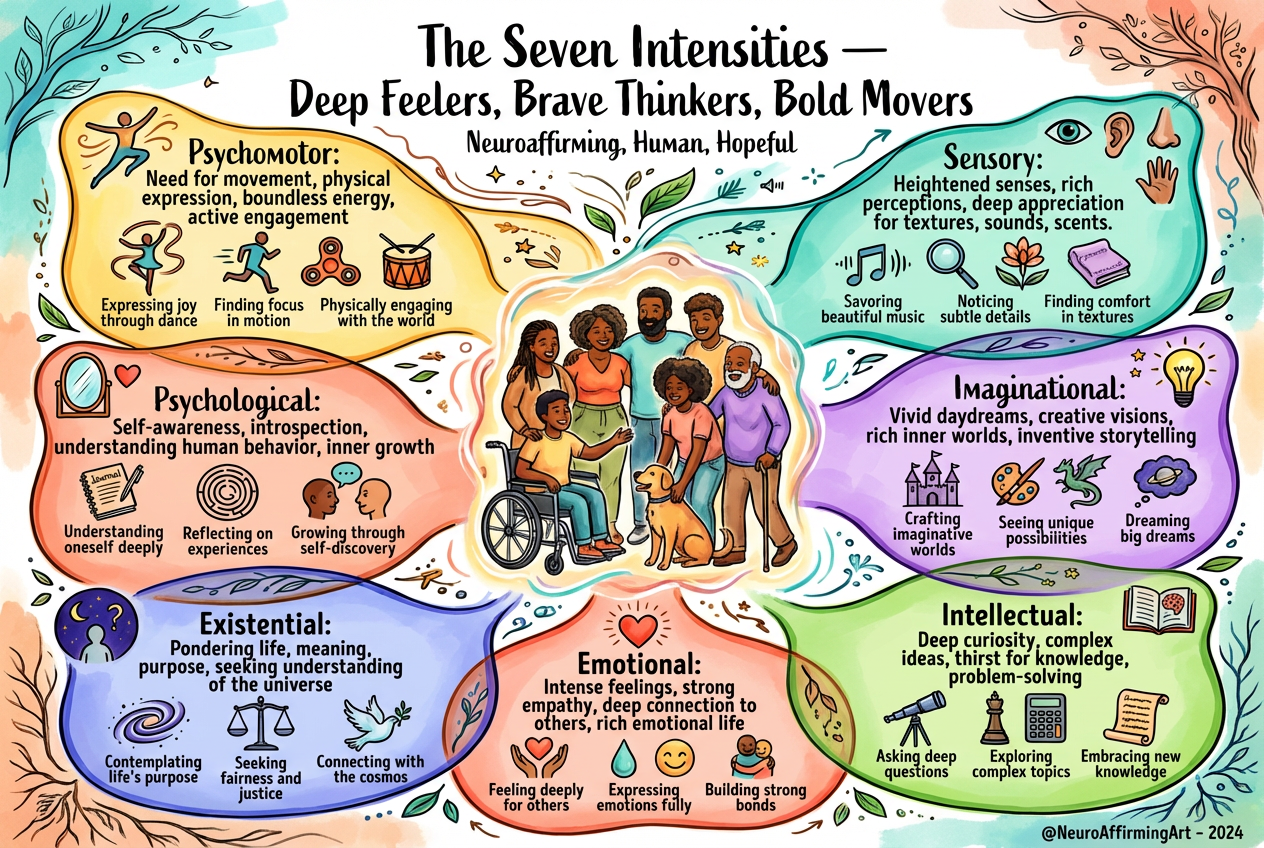
The seven intensities shown here are not traits to manage but ways the human system engages deeply with the world — through movement, feeling, imagination, thought, purpose, and self reflection.
When we meet intensity with attunement and respect, what once looked like “too much” becomes capacity: energy that organizes, sensitivity that connects, intellect that innovates, and emotion that humanizes.
This sketchnote reminds us that support starts with safety, curiosity, and the environment — not with asking anyone to be less.
Origins of the Terminology
The language of intensity didn’t always sound so affirming. You might have heard of “overexcitabilities,” a term introduced by Kazimierz Dąbrowski, a Polish psychiatrist and psychologist, in the mid‑20th century. Dąbrowski developed what he called the Theory of Positive Disintegration. In his view, some individuals experienced life so vividly (feeling more, thinking faster, reacting more deeply) that they often suffered inner chaos. Yet he believed this disruption could lead to higher levels of empathy, moral reasoning, and authenticity.
It was strikingly radical at the time: the idea that emotional struggle wasn’t only pathology but could be potential. That conflict, rather than calm, could foster growth.
The Trouble with the Origin
Of course, Dąbrowski’s theory came wrapped in the assumptions of its era. His work framed “higher” and “lower” levels of psychological development as though there were a single moral ladder to climb. His term overexcitability made us sound like electrical or emotional hazards. You know, hyper, hysteriacal, too sensitive, too reactive, too much. It carried a whiff of pathology that lingers even now.
So yes, it’s a not‑great origin. But, hidden inside its awkward phrasing, there’s insight that is actually quite helpful and well worth salvaging.
A Helpful Concept
What Dąbrowski described, imperfectly, uncomfortably, was the reality that some people’s systems simply register more: more emotion, more sensory input, more thought, more imagination, more movement. These are the intensities. When reframed through a neuroaffirming lens, they become a language for understanding deep responsiveness, not a dysfunction.
When supported within attuned relationships and accessible environments:
- Emotional intensity becomes empathy, moral courage, and connection.
- Intellectual intensity becomes innovation, precision, and insight.
- Sensory intensity becomes presence, artistry, and embodiment.
- Psychomotor intensity becomes vitality and drive.
- Imaginational intensity becomes vision and narrative coherence.
I truly believe that some of our greatest historical thinkers were lucky enough to be neurodivergent brains-bodies with the just-right attuned support systems.
Add to these the existential and psychological intensities — the drive to understand purpose and self — and we find a full portrait of human depth.
So Why Revisit It Now?
Because the world still confuses regulation with restraint. Children and adults who feel deeply are told to calm down, balance out, blend in. But what would happen if, instead of subduing intensity, we accompanied it? Supported it? Designed environments around it?
Even a concept with a “not‑great origin” can become a tool for liberation when reframed with curiosity and respect. Intensity isn’t a problem to manage; it’s a possibility to nurture — one that gives texture, color, and conscience to being human.
In developmental theory, this idea of amplified inner life and responsiveness also resonates with Daniel Stern’s concept of vitality affects—the dynamic qualities of lived experience that give emotion and movement their contour, such as surging, fading, or bursting. Where the intensities describe enduring sensibilities in how a person perceives and processes the world, vitality affects capture the micro‑rhythms of feeling in motion within relationships. Together, they recognize that deep sensitivity and expressive nuance are integral to connection, not evidence of dysregulation.
Let's liberate the language of intensity from its dusty academic roots. Together, we’ll explore what these sensitivities really mean, how they manifest, and what practitioners, caregivers, and communities can do to honor them in everyday life. Join me as we explore this further over the next few weeks.